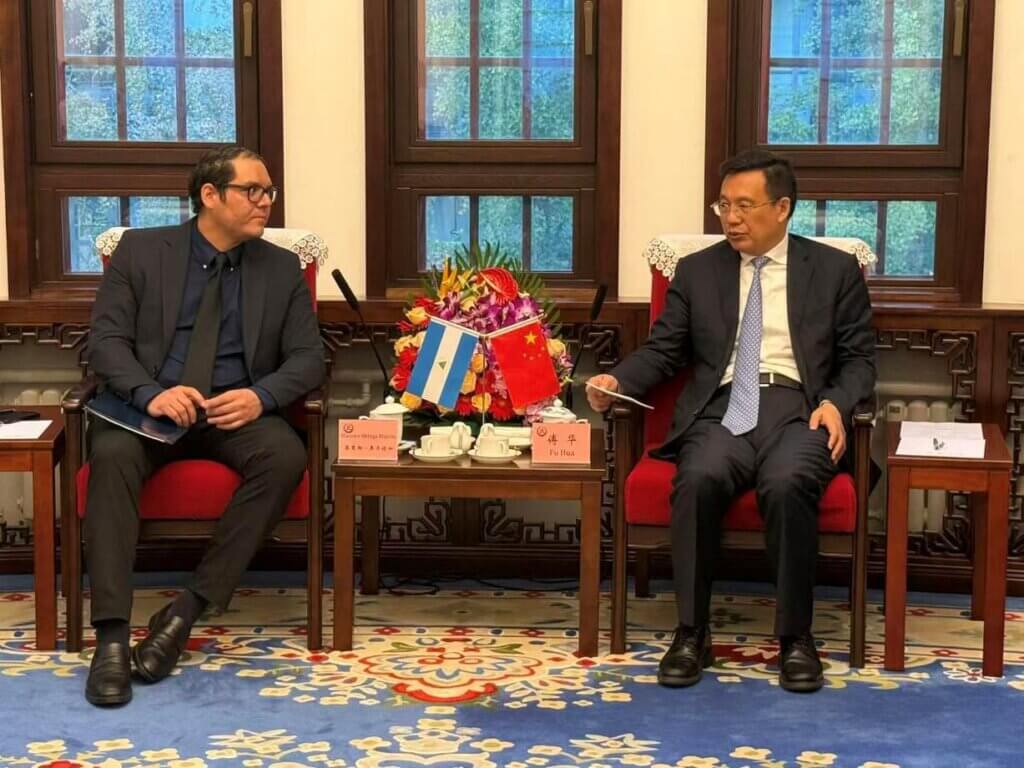
Photo: Atlantic Council.
Experts from Latin America and Africa gathered in Washington, D.C., to examine how countries across the Global South can better navigate China’s growing global footprint. The discussion, hosted by the Atlantic Council’s Global China Hub and the University of Notre Dame’s Keough School of Global Affairs, brought together leading voices to compare regional experiences and identify strategies for exercising greater agency and sovereignty in engagement with Beijing.
The opening panel, titled “Navigating China’s Impact: Strategies for Latin America and Africa”, featured Parsifal D’Sola, Founder and CEO of the Andrés Bello Foundation and Nonresident Senior Fellow at the Atlantic Council’s Global China Hub; Sanusha Naidu, Senior Research Fellow at the Institute for Global Dialogue; Rama Yade, Senior Director of the Africa Center at the Atlantic Council; and Leland Lazarus, Founder and CEO of Lazarus Consulting and Nonresident Fellow at the Global China Hub. The discussion was moderated by Joshua Eisenman, Professor of Politics at the University of Notre Dame.
Representing Latin America’s perspective, Parsifal D’Sola highlighted the structural fragmentation of the region as a key difference from Africa’s collective engagement with China. “African countries present a much more unified front when engaging with China,” he explained, noting that “while the African Union provides a consolidated framework, Latin America’s CELAC remains a loose coordination network without binding mechanisms.” He emphasized that China’s approach to Latin America has therefore evolved into a largely bilateral strategy, one that reflects the region’s low levels of integration and limited intra-regional trade.
“For Latin America, agency means realism, balancing relationships with both China and the U.S. without becoming reactive. The goal should be to use great-power competition to national advantage, not to be used by it,” said D’Sola.
D’Sola also underscored that while Chinese investment has increased, the United States and the European Union remain dominant economic players. “Chinese FDI is only five to six percent of Latin America’s total; the U.S. and EU together still account for over sixty percent,” he noted, adding that “China dominates the headlines, but the underlying numbers tell a different story.”
South African scholar Sanusha Naidu opened the discussion by outlining how Beijing’s engagement model evolved from its early experiences in Africa.“China has used Africa as a kind of peer-learning ground for shaping its strategy in Latin America,” Naidu explained. “It adapted what worked in Africa, from resource extraction to institutional learning, and applied it to local Latin American conditions.” She added that China’s approach is no longer just about commodities but about developing ecosystems of infrastructure, commerce, and cultural exchange. Naidu also warned that competition among African states for Chinese projects has often diluted collective leverage: “Agency must be both national and subnational, extending beyond governments to people-to-people engagement.”
Former French diplomat and current Africa Center Director Rama Yade emphasized the long historical and political ties underpinning the China-Africa relationship, tracing them back to Beijing’s re-entry into the United Nations in 1971 with African support.“That debt of gratitude still shapes policy,” Yade said. “This relationship is not static; it’s becoming greener, more diversified, and more people-centered. And if other actors, especially in Washington, don’t engage meaningfully, China’s influence will continue expanding.”She pointed to Morocco as a successful example of pragmatic engagement, balancing ties with both China and the United States while pursuing active South-South cooperation: “Through Morocco’s experience, we can see how Africa’s trade with China might evolve; more integrated, but also more self-directed.”
Bridging the African and Latin American experiences, Leland Lazarus presented comparative insights on China’s global operations.“The same Chinese policy banks and state-owned enterprises operate in both regions, even the same executives rotate between continents,” Lazarus noted. “For instance, executives who worked on port projects in Africa later moved to lead operations in Latin America.” He also highlighted a key takeaway from recent cross-regional dialogues: “One word emerged from our Africa-Americas Forum on China: agency. Both African and Latin American countries want to be rule makers, not rule takers, especially in emerging sectors like AI and green technology.”
Throughout the conversation, panelists agreed that the next phase of China’s engagement will not be defined solely by trade and infrastructure, but by knowledge production, technological cooperation, and discourse power, particularly as China expands its influence in media and education across both continents.
The discussion underscored the importance of learning across regions, with Africa and Latin America facing similar opportunities and dilemmas as they navigate relations with major powers. As Parsifal D’Sola concluded, “The challenge ahead is to convert great-power competition into developmental opportunity, not dependency.”
Learn more about the event:
Navigating China’s impact: Strategies for Latin America and Africa – Atlantic Council